


Most brands treat post-purchase emails as functional necessities. These automated emails are built into the purchase workflow and focus almost exclusively on the product and the buying experience.
You see these emails in your own inbox:
- “Thanks for your purchase.”
- “Your product is on its way.”
- “Here’s an updated shipping schedule.”
- “We just delivered your purchase.”
- “Rate your experience.”
Nothing wrong with these emails. In fact, customers rely on them to be sure they bought the right color, size and model and to know when to expect it.
But if that’s all your post-purchase emails are doing, you’re missing a key step to cement the relationship, build confidence and trust, make your brand stand out from the competition and come back to buy again.
That missing step? Helpful content that answers the questions your customers aren’t asking out loud.
How smart brands use the post-purchase moment
They see post-purchase as the point where confidence is either reinforced or eroded. The moment customers click “Buy” is also the moment they start asking themselves questions like these:
- Did I choose the right brand?
- Will this actually work for me?
- What if I don’t know how to use it properly?
See the difference between the messages you send now and the questions your customers are asking themselves? They go beyond the purchase into customer confidence.
The brands that answer those questions before they’re asked are the ones that build loyalty, trust and long-term customer value.
Address these fragile moments in the customer journey
Immediately after they buy, customers move from emotional decision-making to analytical reflection. This is where the two systems of thinking described in Daniel Kahneman’s landmark book, “Thinking, Fast and Slow,” kick in.
System 1 (immediate, emotional, intuitive) says, “I want this!” System 2 (logical, rational) follows up with, “Was that a good idea?”
Silence from your brand during this phase creates space for doubt. Helpful post-purchase content fills that space with reassurance, clarity and competence. Even your best post-purchase emails won’t answer these questions if they address only the procedural questions about the purchase.
By going beyond that limited focus, you help customers build confidence in your brand and instill the trust that drives repeat purchase, advocacy and higher customer lifetime value (CLV).
I’ve broken the journey from purchase to use into six phases. Two occur before the purchase arrives and four address issues that can arise after unboxing. I’ve also chosen an email example to illustrate the phase and provided a rationale for the message.
1. Reduce uncertainty while customers wait for their purchases to arrive
Some of the strongest post-purchase emails arrive before the product does. This is not accidental.
Waiting is a psychologically uncomfortable state. Customers have paid, but they can’t validate their decision immediately, unlike when they buy in a physical store.
However, this anxiety-inducing period opens a window for your brand to reinforce value and reduce uncertainty.
Explain the why behind your product as Lialys does in this example.
- Subject line: Hair Days Are Coming Your Way
This email reframes shipping as a story instead of a timeline. It supplements the view-at-a-glance tracker (which is all some customers need) with a storytelling narrative that shares the personal story that led to the product and takes customers behind the scenes with design sketches and craftsmanship stories.
All of these elements tell a powerful message: This product is considered, refined and cared for. That reassurance builds confidence in the brand before the customer has even touched the product.
Your customers search everywhere. Make sure your brand shows up.
The SEO toolkit you know, plus the AI visibility data you need.
Start Free Trial
Get started with

2. Set expectations without overwhelming
Pre-arrival content works best when it informs without instructing too early. Without a product in hand, those instructions can be irrelevant or even instill a little doubt, with customers wondering whether their purchases should have arrived already.
Instead, prep customers for what to expect. Explain what makes the product different. Prepare customers for the first use and let them know how you’ll support them if they have questions when the time comes.
PrimeLash Mascara offers things to think about before the product arrives.
- Subject line: Your PrimeLash Mascara is zooming to you
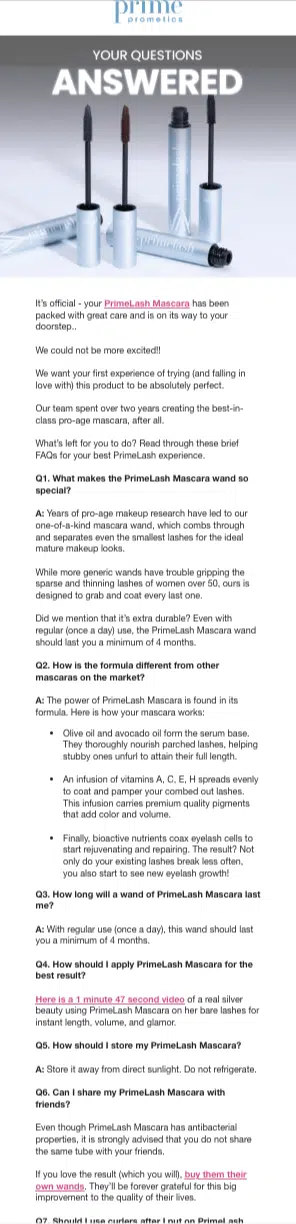
This email anticipates concerns before they arise:
- How long the product lasts
- What makes it different
- How to store it correctly
It removes ambiguity at a time when customers are most likely to overthink their purchase — protecting trust and reducing post-purchase regret.
Your customer service team can supply relevant content here. Ask them for the customer questions they receive most often or repurpose your website FAQ in an email-friendly format.
3. Shift from reassurance to empowerment after the product arrives
Once the product is in the customer’s hands, the post-purchase content changes. Now your goal is to help them succeed with your product.
Don’t assume customers already know how to use your product. Even if it’s an everyday product, like the mascara in the previous example, you reinforce the idea that your product is different by offering a learning curve.
Lialys also includes a simple how-to in their emails.
- Subject line: You’ve got them. Now let’s use them.
This email doesn’t sell. It teaches. Its underlying message is not “Here’s what you bought.” Instead, it says, “We’ve got you! We’ll help you use this product right.”
It welcomes new customers, walks them through a simple tutorial and leads them to a video that makes the process even clearer.
This message of support will drive customer success and brand loyalty — two factors that lead to repeat purchases.
4. Normalize struggle without shame
One of the most overlooked aspects of post-purchase content is emotional reassurance. When customers struggle silently, dissatisfaction grows. When brands acknowledge that struggle is normal, trust deepens.
Offering a quick check-in helps.
- Subject line: How’s your new hairpin?
This email is a master class in behavior-aware design and is designed to help customers either feel good that they have succeeded at the task or feel reassured that they aren’t the only ones having issues.
The statement below the second answer also reinforces this brand’s commitment to customer satisfaction with a short but clear statement. It also gives customers a clear next step for either outcome.
This type of interaction makes customers feel seen, not measured. It keeps them engaged instead of disappointed. This will help to protect CLTV.
5. Use education as a loyalty strategy
Educational content does more than reduce support tickets. It increases perceived value.
When brands teach customers how to care for, use and get the most from a product, they’re extending the relationship beyond the transaction.
Here, SilkSilky explains the why.
- Subject line: Silk care made easy. Protect what you love
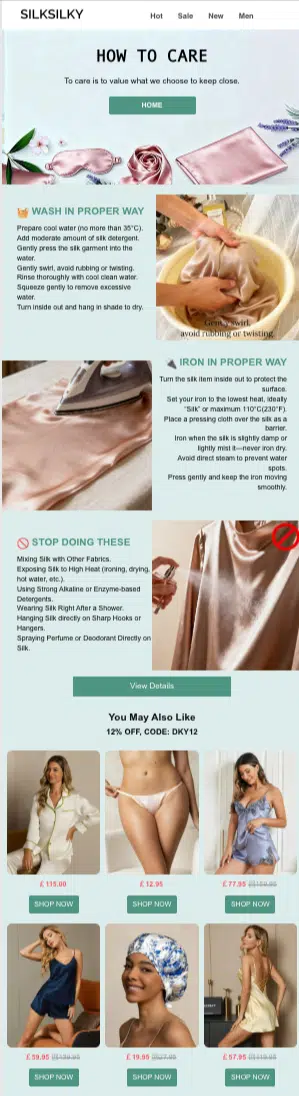
This email sets the tone right away with the opening line: “To care is to value what we choose to keep close.” It implies that the brand’s products are worth caring for — an approach that treats product care as a sign of respect, not just rules to follow and subtly refutes the fast-fashion mindset that promotes discards over care.
It also assumes that customers don’t know how to care for its products and explains why each step is essential. The overall message is that the company’s products are worth the care they require. If the company appears not to care whether their products satisfy, why should the customer?
Customers who feel supported are far more likely to return, explore new products and stay loyal, especially when cheaper alternatives exist.
6. Apply personalization without pressure
Helpful post-purchase content becomes even more powerful when it adapts to individual needs.
In this example, Merwave follows general how-tos with more detailed advice
- Subject line: Ready for your first Merwave wash?
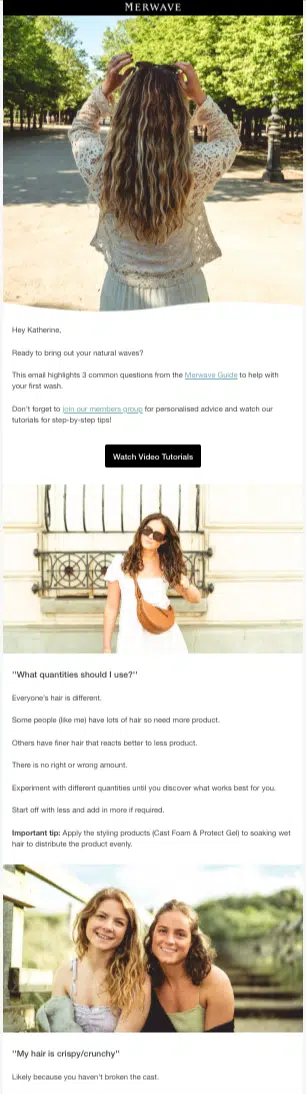
Although this email appears to be a standard first-steps message, it breaks from that mold by focusing on how different customers can achieve different outcomes with the same product.
It acknowledges how hair types can influence users’ experiences and encourages experimentation. Instead of implying that there are only a few ways to experience the product, the guide offers guidance without setting rigid expectations.
This flexibility increases confidence and reduces fear of doing it wrong — a key factor in long-term satisfaction and retention.
Why this approach increases CLTV
Although each of these emails is different, they share a common thread. They don’t push for the next sale. I can hear traditional marketers moaning about that. But that’s why helpful post-purchase emails work.
- They increase customers’ confidence in your brand, especially among first-time buyers.
- You can reduce post-purchase anxiety and regret, thereby reducing product returns and cutting your losses.
- You help customers succeed quickly — another boost to loyalty.
- Helping customers navigate your products builds emotional loyalty.
- All of these factors together encourage repeat visits and purchases organically, without resorting to bounce-back or future-purchase discounts.
Your profit margin will thank you!
The constant drive for conversions can kill the delicate connection you have with your new purchasers. Yes, you can always link to the website so customers who want to buy something else can do it easily. And yes, an email such as a next-logical-product purchase suggestion is fine to send — just not as part of this sequence.
The philosophy behind the guidance
Helpful marketing is strategic. I’ve built my email career around the idea that marketing that aims to help customers first will also help the company. If customers don’t see value from your products, the system failed first. Post-purchase content allows your brand to demonstrate that it deserves repeat business.
The brands you see here understand the fundamental rules of customer loyalty. It’s not just about discounts or promotions. Loyalty builds in the quiet moments, after checkout, before the next promotion.
Post-purchase emails shouldn’t ask, “What can we sell next?” The real question is, “What does our customer need now?” Customers who feel confident, capable and supported don’t just come back. They stay. That’s how your post-purchase email program creates sustainable lifetime value.
Read the full article here