


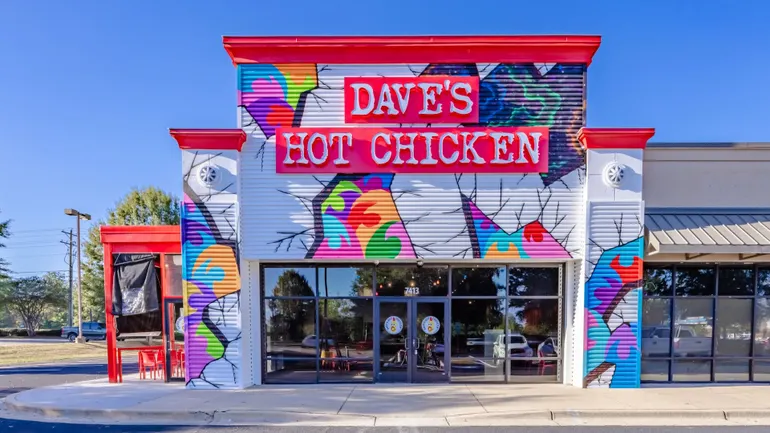
Founded as a parking lot pop-up in 2017, Dave’s Hot Chicken has quickly emerged as a disruptor in the fast-casual industry thanks to its take on Nashville-style hot chicken. Roark Capital, the private equity firm that controls Subway and Inspire Brands, last year took a majority stake in the brand with a deal reportedly worth about $1 billion.
To better prepare the chain for its next stage of growth, Dave’s in December appointed Brandon Rhoten as CMO, with a remit covering brand marketing, creative strategy, digital and social engagement and media.
Dave’s Hot Chicken CMO Brandon Rhoten
Courtesy of Dave’s Hot Chicken
Previously, Rhoten served as CMO of advertising platform GroundTruth, which had worked with the chain. Before that, he served as global CMO for Potbelly and spent six years leading creative and social strategy at Wendy’s, helping establish the brand’s social media presence and game-changing tone.
Marketing Dive spoke with Rhoten about what attracted him to Dave’s, how the brand approaches value and what’s in store for the marketer in 2026.
The following interview has been edited for clarity and brevity.
MARKETING DIVE: What did you see in Dave’s that drew you to the brand from a marketer’s perspective?
BRANDON RHOTEN: It’s a brand that has an amazing social following. It’s a brand that has established itself well as an outsider in the chicken space and it has a great reputation among customers. Yelp just voted it a most-loved brand, beating out Chick-fil-A, Raising Canes and the big guys.
They’re on good footing, but it’s a brand with only a few hundred locations right now, so it’s still in its infancy. It hasn’t done any [marketing] on major stages yet. It hasn’t run any serious, broad, national media buys. It hasn’t even scaled a lot of the typical things that a QSR or a fast casual would do.
A lot of tools in the toolbox are yet to be explored for marketing, so I’m doing the homework on what’s worked in the past: Where are the correlations to traffic growth, what mediums that they’ve attempted, and what marketing tactics they’ve tried resulted in a lift to the brand and created brand love and lifetime value among among guests. Then we’re gonna start playing around with that bigger toolbox in 2026, for sure.
A major theme in restaurant marketing for the last few years is value. How does Dave’s play in that space?
Shake Shack and Chipotle are examples of [brands] that tend not to do a lot of value plays or deals, specifically things like BOGOs or price-pointed items, and they’re starting to do that to essentially keep their heads above water.
Dave’s is not a discounting brand. I think our orientation is going to be around bang for the buck and quality, and the idea that it’s a meal worth paying for. Having said that, we’re watching it very closely. We have a huge loyalty program, like a lot of folks do, with millions of members, so that gives us an opportunity to experiment with things that allow [consumers] to trial us, come more often and provide some incentives.
But, like Cava, our intention is not to be a discounting brand. Our intention is not to start advertising value menus or anything of that nature, because we feel like the product is worthwhile and we’re willing to take a hit on traffic. There’s a balance to be struck. You can get to the point where your pricing is just too crazy, and people stop coming. We don’t want to be that brand.
I’m digging through all the external data that we have on the brand value, and perceptions are actually very strong for Dave’s, and have been improving over the course of 2025. I don’t think many brands can say that. I’m the guy who launched 4 for $4 at Wendy’s, so I understand value and its role, but at Dave’s, it’s more about bang for buck, and we’re going to try to hold to that as best we can.
Speaking of your time at Wendy’s, can you share what you learned from that experience?
At the time I joined Wendy’s in 2011, the upstarts and fast casuals were devastating QSR. Five Guys, Chipotle and all the new upstarts were stealing from QSR, and the brand had been on nine or 10 years of traffic declines at that point.
As part of the new team that came in, I was asked to build up digital-social as a practice and create that team and that program. We went back to the heart of what Wendy’s was: It was, “Where’s the Beef?” back in the day. It was calling out competitors, standing on quality and pushing against the industry.
Wendy’s was the first brand ever to go on television and call out other brands for the quality of their product. Fighting with other brands on Twitter and other social platforms was in the brand’s DNA. We saw growth, along with a lot of other work that was done. It wasn’t just the social stuff, but it was a lot of stuff that was done to make that brand grow. I’m a big believer that you start with what’s core to the brand.
How do those lessons apply to Dave’s?
Dave’s is a brand that grew up on social. This is a brand that has a per-restaurant count of followers on TikTok, on Instagram, that beats everybody by a long shot. The general presence is very strong. I want to build on that. We’ve done that pretty much through organic use. You can leverage that to scale other mediums. We run CTV ads right now, and our creatives are all from social. They aren’t paid influencers. These are just things found in the wild that we reach out to the influencer, or just a normal person, and say, ‘We’d love to use you in a video ad.’
Other brands are using that sort of stuff sometimes, but not as their core way to go to market, and that’s worked really well for us. We’re just spreading the love that people have in that moment they bite into the sandwich and their eyes roll back in their heads.
This isn’t a brand that’s been on big stages yet. It’s still relatively small and its media spend has been very narrow, so our opportunity is to expand that. What you’re going to see from us in 2026 is a lot of testing to figure out what actually gets us traffic, because that’s what matters. What I don’t want to do is go out and do a TikTok dance, because that’s not the brand. I want to stay true to the authenticity of the brand and the real love people have and just put it on stages where more people can see it.
How are you approaching ROI as you level up Dave’s marketing?
Marketing is art in the service of commerce. That’s not my quote, I stole that from somebody, but that’s what it is. Our job is to get people to show up, so it’s essential to have attribution to your media. It’s essential to understand what each medium does. It gets complicated as the mix becomes bigger and as the spend becomes bigger, but there are great tools out there to do it now.
Dave’s did that in its early days, to understand which mediums to get into. That’s why they got into CTV, as an example. We have to figure out what mediums actually drive that traffic and create that sticky customer that has a longer lifetime value.
I’m building in attribution to everything we do going forward. That’s going to let us understand, as we get on these bigger stages, what’s working. There’s always a part of marketing that’s not clearly measurable, and we will do things that aren’t measurable, that are just for attention or establishing the brand. But at the end of the day, the majority of the spend has to have a clear line of sight to traffic.
You mentioned Dave’s loyalty program. How does that feed into other marketing efforts?
We’re just north of 3 million total users in the app. It’s a huge base driven mostly from brand love. But we haven’t gone deep with that. There’s no segmentation right now. There’s no regionality right now. There’s all sorts of low-hanging fruit there.
It’s a pretty standard program right now. Dave’s is an interesting brand. People want to wear our stuff. It’s a little bit of a status brand right now, and we want to maintain that, so we’re going to be building in layers that are much more about earning your way to that loyalty and in ways that aren’t necessarily just [free food].
You walk into one of our stores, the vibe and the experience of the product is so different than everyone else. We think people want to take that with them in some capacity. You’re going to be seeing us making some significant shifts to the CRM program to build it up so it represents the brand in a much more meaningful way.
Read the full article here