


The media landscape in which marketers operate continues to transform, approaching an inflection point where decades-long goals appear in reach and bandied-about technologies begin to deliver on promises, according to Proctor & Gamble Chief Brand Officer Marc Pritchard.
The marketing executive discussed how the CPG giant is tackling this transformation, which includes media fragmentation, a shift to digital commerce and the power of artificial intelligence to “exponentially turbocharge” marketing, during a session at the Association of National Advertisers’ Media Conference on March 26.
“There’s these massive shifts that are facing consumers today that we need to deal with in terms of how we build our brands,” Pritchard said, noting that, “The fundamentals still matter… Who your consumer is, what your brand stands for, how you come up with insights, ideas and executions so you can connect with them on product packaging, retail communication and value. But how we do that has completely changed.”
Those fundamentals come into play in establishing a brand that helps consumers build memory structures across channels including TV and social media in both short- and long-form video content. But they are also crucial amid the convergence of commerce and media, the growth of AI in nearly every facet of marketing and the need for simpler cross-media measurement.
Voices united
Along with brand voice, marketers must work to boost expert voices and the consumer’s voice that are both evolving. In the former, celebrities have given way to influencers and creators and soon might be replaced by AI agents; in the latter, the bedrock principle of word-of-mouth can now be scaled in a massive but still organic way.
“Finding that right mix across your brand to build awareness, build memory, keep reminding people to endorse in a way that is genuine, and then connect it directly to commerce, that’s the how those voices all work,” Pritchard said.
To illustrate how these voices work together, Pritchard pointed to Old Spice, a core P&G brand that has seen accelerated growth by turning consumer insights into innovations that are then executed in brand communication and retail execution. Despite the rise of AI in the creation of ad creative, Pritchard noted that the company still works with top creatives at top agencies to generate brand ideas. A recent Old Spice campaign created with agency Wieden+Kennedy tapped into cultural nostalgia.
“Creativity still matters. Long-form communication still matters. Building memories about this brand still matters, so we still do that. We still work with creators to make that happen. We also translate that into short-form social assets to remind people and connect those directly to commerce,” the executive said.
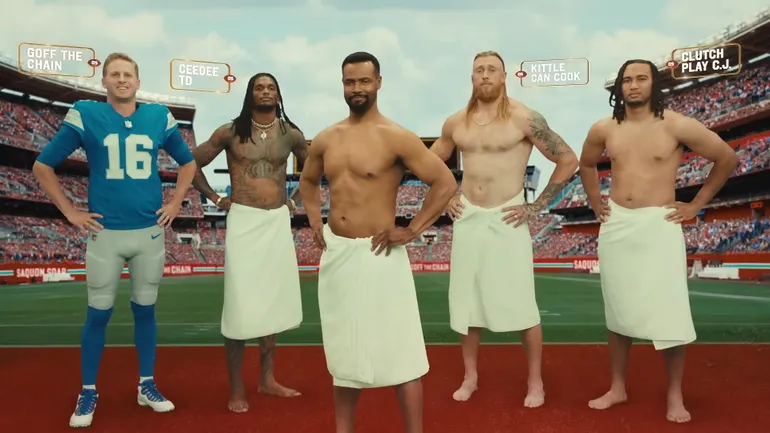
Old Spice’s campaign around the NFL last season demonstrated P&G’s approach to tying together brand, expert and consumer voice across channels. The campaign kicked off with an ad featuring the marketer’s brand mascot alongside NFL players, who were then featured in ads cut down for social platforms to boost retail tie-ups. The campaign also included user-generated content on TikTok. Across all communications, consistency was key.
“What’s important in today’s world with this massive fragmentation is you’ve got to be ruthlessly consistent, and you’ve got to find the things that matter, the brand assets that matter, the ideas that matter, and then make sure that that shows up with the people who are going to speak on your behalf,” Pritchard said.
AI is still a work in progress
Pritchard has been speaking for years about how AI is transforming advertising, but still described how P&G works with the technology as a “work in progress” as the company moves from a siloed, batch-based process to more of a continuous one typical of direct-to-consumer brands.
The executive during his ANA chat highlighted how P&G’s fabric care business has used AI tools to accelerate innovation and go-to-market strategies. After meeting with retailers at the beginning of the year, the fabric care business organized sprints that leveraged AI tools and data to come up with insights, concepts and a prototype ad before executing a media plan — all in about three weeks. Tide was able to generate a 10-times increase in assets in a short time, while Gain’s quick speed helped move business results. Along with AI tools, Pritchard credited the speed to how its marketing teams are structured and organized.
“We have our integrated brand teams who work with what are essentially in-house agencies. We already in-housed our media. We’re in-housing a lot of the advertising and content creation, as well as key opinion leaders, and then we’re connecting it directly to retail,” he said.
In response to a question of how P&G’s use of AI tools lines up with consumer anxieties around the increasingly ubiquitous tech, Pritchard maintained that marketing work that uses AI but stays true to fundamentals will be unscathed, comparing AI to animation, CGI and other familiar technologies.
“It’s when it does it in a way that people look at and think you’re trying to dupe [them] in some way, then that’s not going to work,” Pritchard said of AI-generated ads. “I think what will happen is most of the work that we see out there in our industry, at least, is responsible.”
The same can be said of AI chatbots and large language models that have quickly become the focus of how brands communicate with consumers. P&G is spending “an enormous amount of time” figuring out how to communicate its information for LLMs. But ultimately, AI is another tool in a lineage that includes the printing press, television and the internet — tools that required upskilling alongside fundamentals.
“All these things are technologies that have allowed us to do what we do best, better, faster, cheaper and now at scale,” the executive said. “Get practice with these tools, because at the end of the day, it’s repetitions that make people more effective at getting this done.”
Measurement’s holy grail
Just like AI, measurement has been a topic of discussion for marketers for years, if not decades. Media fragmentation has continued, and even if some streamlining can be expected amid consolidation, cross-media measurement must get simpler, Pritchard said. Thankfully for marketers, Aquila — the measurement unit established by the ANA in 2024 — will be rolling out in 30 days, executives said earlier in the day at the conference.
“We’ve been chasing this holy grail now for a long time, and now there’s a solution, and it’s Aquila,” Pritchard said.
Aquila unites census-level impression data from Meta, Google, Amazon and TikTok with linear TV data from Comscore and streaming data from Samba TV. The buy-in from across the media landscape comes as all players want an efficient, effective ecosystem that spurs growth. But marketers still need accurate retail signals instead of proxies like media mix modeling, return-on-investment and reach frequency.
“I would just focus, as an industry… on cross-media measurement [and] retail sales signals for closed loop attribution. We get those two measurement things, we’re going to then take this to another level,” Pritchard said.
Overall, Pritchard’s advice for marketers is to get “in shape” for the continuous sprint that marketing has become thanks to transformation across many dimensions. In the same way that AI has sped up advertising, processes and mindsets must reflect acceleration.
“You’ve heard me say before that I fire myself every 18 months to rehire myself, so I can look at the future with a very objective eye,” Pritchard said. “I probably do that every day now because that’s how rapidly things are going.”
Read the full article here