

Email and SMS didn’t undergo a seismic shift in 2025, but they did change in ways that materially affected performance and strategy.
Three updates, in particular, reshaped how messages are delivered, displayed and engaged with across email and SMS campaigns:
Based on what we are seeing in the back end of programs entering our agency’s pipeline in late 2025 and early 2026, there is significant room for improvement for brands looking to fine-tune their email marketing in the months ahead.
Apple’s iOS 18.2 rollout: What it does and how marketers should adjust
iOS 18.2 was released at the end of 2024, but the updates and their impact became clearer as 2025 unfolded.
First, the updates:
- Inbox visibility changed: New tabs were introduced, reducing Primary inbox exposure.
- AI-generated previews expanded: Apple’s AI summaries replaced preheaders in some views, limiting marketers’ control over first impressions.
- Engagement signals became harder to read: Grouped emails, untrackable “See more” clicks and existing Mail Privacy Protection further clouded already limited open and click data.
- Live text gained importance: AI summaries rendered more effectively from HTML and live text than from image-heavy emails.
Here are my recommendations for mitigating the impact:
- Optimize for engagement, not opens: Double down on personalization, segmentation and journey-based sending.
- Make subject lines work harder: Highlight offers, urgency and promotion duration to stand out in tabbed and grouped views.
- Use transactional emails: Drive engagement and send them from the same environment as marketing emails.
- Prioritize live text over images: Improve AI summary quality and accessibility.
- Plan for inbox grouping: Design content calendars with send succession and visual differentiation in mind.
Dig deeper: Apple and Gmail make it harder for email campaigns to get to the inbox
Gmail’s ‘Manage subscriptions’ feature (and why segmentation matters more than ever)
Gmail’s Manage subscriptions feature gives users a centralized view of active subscriptions and makes it easier to unsubscribe, particularly from high-volume senders.
The feature’s design is worth noting. Subscriptions are sorted first by email volume, then alphabetically. This reinforces an existing reality: Send frequency is one of the biggest drivers of unsubscribe behavior, especially when it outpaces engagement.
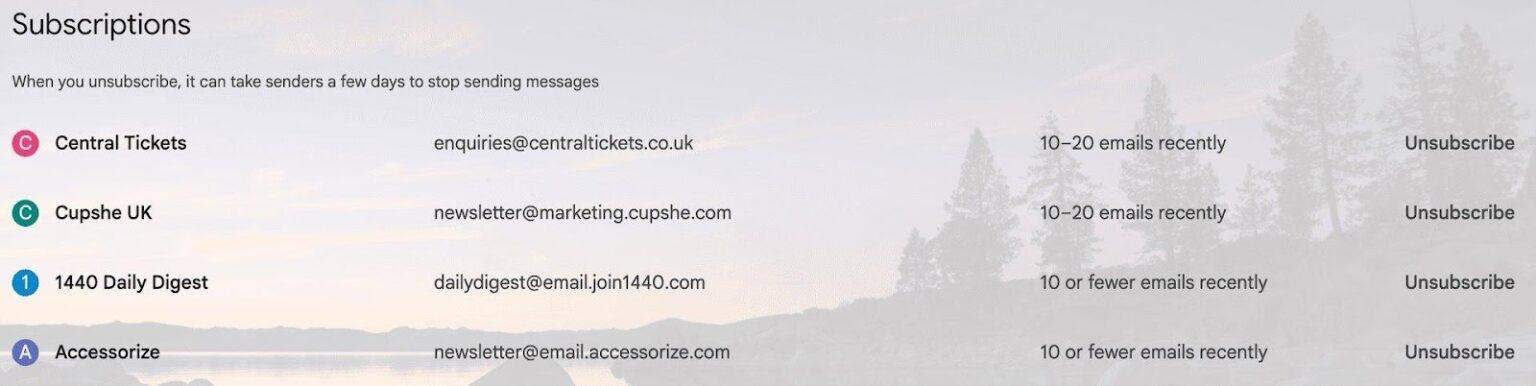
Rather than introducing a new problem, Gmail made an existing dynamic more visible to subscribers.
Here are the adjustments we have made to client accounts to minimize the update’s impact:
- Align send frequency to engagement levels: Reduce frequency for low-engagement and at-risk segments. Reserve higher cadence for highly engaged subscribers. This minimizes exposure in the Manage subscriptions list for users most likely to churn.
- Double down on intelligent segmentation: Create distinct segments for highly engaged, low-engagement and inactive users. Adjust cadence, content or pause sends entirely for disengaged segments.
- Treat unsubscribes as a signal, not a failure: Subscribers who use this feature are often the same users who would have unsubscribed anyway.
- Monitor overall list health as disengaged users leave.
- Expand the view of metrics to evaluate deliverability over time as lower-quality subscribers drop off.
Dig deeper: More AI for the Gmail inbox isn’t the end of email marketing
How to keep your brand out of Apple’s ‘unknown sender’ SMS segment
SMS had its turn in the spotlight with Apple’s iOS 26 update, which improved the “Unknown Sender” filter and can divert brand messages out of the primary message view, similar to email promotion tabs.
Overall impact has been muted so far. Most users are unaware of the functionality, and Apple has not prompted users to opt in as part of updates to date. However, if adoption increases in future updates, the impact could be significant.
For the small percentage of users currently leveraging the feature, broad SMS campaigns have been most vulnerable. Because most consumers do not save brand numbers as contacts, many nonpersonalized messages are filtered.
Engagement disruption is likely. Brands without strong subscriber relationships should expect declines in SMS engagement and prepare accordingly as adoption increases.
Here’s how we have been helping clients adjust:
- Shift from volume to value: Reduce frequency and prioritize personalized, event-driven SMS over broad promotional sends.
- Prompt “known sender” actions: Encourage users to add the brand as a contact or mark messages as known, especially post-purchase, during delivery updates or in welcome flows.
- Use high-utility messages to build trust: Leverage order confirmations, shipping updates, back-in-stock alerts and price-drop notifications to reinforce relevance.
- Keep SMS distinct from email: Tune messages to be concise, authentic and timely. Over-messaging increases opt-outs and filtering risk.
- Monitor and iterate aggressively: Track KPIs over time and refine content, cadence and triggers as behavior trends become clear.
When should you tackle all of these changes? ASAP. More updates are coming this year, and brands that react quickly will maintain an advantage over competitors.
Dig deeper: Why syncing email and SMS is critical to marketing success
Fuel up with free marketing insights.
Contributing authors are invited to create content for MarTech and are chosen for their expertise and contribution to the martech community. Our contributors work under the oversight of the editorial staff and contributions are checked for quality and relevance to our readers. MarTech is owned by Semrush. Contributor was not asked to make any direct or indirect mentions of Semrush. The opinions they express are their own.
Read the full article here